 Mallorca.dev
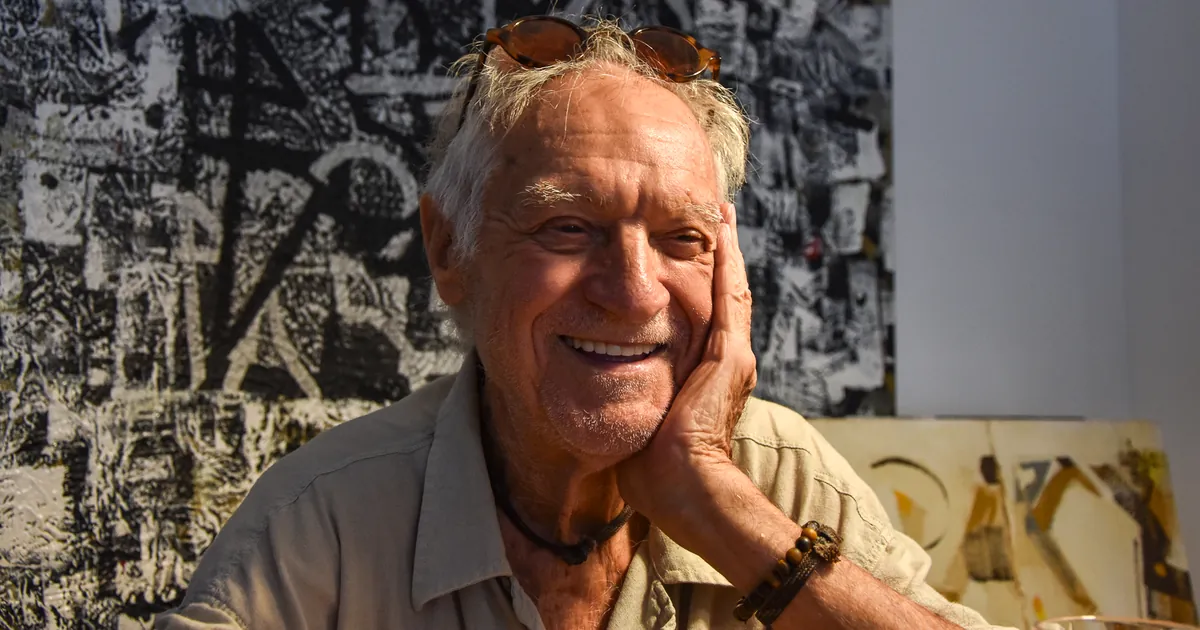
A Chalk Mickey by the School Gate: the Painting of Antonio García Mulet of Palma
Near the primary school in his neighbourhood, Antonio García Mulet once noticed a Mickey Mouse drawn in chalk. The silhouette was close enough to be recognised at a glance, and drawn with the loose freedom of something done in a hurry. That is how the French critic Jean-Jacques Lévêque tells it. Mickey, he writes, was seen, admired and adopted. From then on he returns in the painter’s work as a recurring sign, “d’alerte et de complicité”: a warning signal and a wink to anyone who spots him.
It is a good way into the work of a painter who lives in Mallorca and whom very few people on the island have heard of.
Barcelona, Palma, Algeria
García Mulet was born in Barcelona on 17 November 1932, the date given both by the Paris museum that holds his work and by the website devoted to him. His family tie is to Palma: according to that website, his mother came from the city and he spent his youth there. In 1949 he left for Algeria and worked for years among architects. Around thirty, in 1962, he moved to Paris and began to paint.
Paris and the gallery on rue de Vaugirard
In Paris he joined the circle of Le Soleil dans la Tête, a gallery at 10 rue de Vaugirard. His website dates his first solo show there to 1970, and an auction catalogue preserves an independent trace of the connection.
In 1977 the gallery’s artists put together a box of fifteen original works. The critic Pierre Gaudibert wrote a text for it, and the whole thing was meant as a “trace of the present” and an act of solidarity to help the gallery survive. Inside were a collage, a pastel and an object print on card, among others. García Mulet contributed a square pen-and-ink drawing, 36 by 36 centimetres, signed and dated lower left. The gallery showed the project from 2 to 23 December 1977. A copy of the box came up at Drouot in Paris in June 2023 (Crait-Muller catalogue, lot 61).
His paintings circulate on the market more widely. The auction database askART lists 31 lots, most of them sold, and the Paris house Ader has offered his acrylics titled “Composition” from 1986 and 1991, with provenance from Galerie Jacquester.
Madrid, 1975: an anthill that sounds like Bach
In March 1975 his paintings were shown in Madrid. The reviewer of the daily Pueblo saw something like an anthill in them: among strong black strokes, a swarm of small signs, here a fragment of a figure or an object, there a script nobody could read. In the end the critic reached for music and heard Bach. Even where the lines seemed to fight one another, he admired the precision with which the painter kept them in hand (Pueblo, 19 March 1975, p. 27).
Mickey as a sign
In that swarm of signs Mickey is easy to miss, which is the point. Lévêque describes how the painter worked him into the movement of the drawing so that he stays there for good, legible to anyone who knows where to look. On canvases with the gravity of abstraction he brings play, and he ties them back to a chalk drawing by a school.
Back to Mallorca
In 2000, according to his website, García Mulet returned to Mallorca. The website lists a good deal more, including a prize at a biennial in Ravenna, a dedication from Joan Miró and shows at FIAC; I could not confirm those in other sources. The site is written in Polish by people close to him, and the only Wikipedia article about him is in Polish too, so the fullest account of a painter living in Palma is one most of the island cannot read.
I found no work of his on permanent display in a public collection on the island. For art in Mallorca you can go and see in person, our directory covers checked studios and artists in Palma.
One drawing to look at
The best place to start is a work that has been in the Musée d’Art moderne de Paris since 1978. It is an untitled drawing in Chinese ink and coloured inks on paper, signed briefly in the lower left corner: “Mulet 78”. It entered the collection in November of the year it was made, and the museum offers an enlargeable reproduction (the drawing in the Paris Musées collection).
Look closely at a single line, then step back and see whether you can hear the Bach. And whether, somewhere among the signs, a silhouette from a chalk drawing flickers past.
Correct as of November 2026. Sources: the collection of the Musée d’Art moderne de Paris (Paris Musées), the daily Pueblo of 19 March 1975 (Biblioteca Virtual de Prensa Histórica), the text by Jean-Jacques Lévêque, the Crait-Muller auction catalogue of 9 June 2023, askART, the auction records of the Ader house and ARTEINFORMADO. Biographical details marked as coming from the artist’s website have no independent confirmation.
If you have catalogues of his exhibitions, press cuttings or photographs of his work from those years, please get in touch. I will gladly add to this text.
I have not spoken to the artist or to the people running his website. Facts from the museum, the press and auction catalogues are linked to their sources; anything that comes only from the website devoted to the artist is marked as such.