 Mallorca.dev
Importing a Car to Mallorca from Outside the EU: The UK and US Route, Step by Step
My own import was from inside the EU. The non-EU route described here, including customs clearance, the 10% duty and individual homologation, comes from AEAT guidance and specialist sources rather than first-hand experience.
I moved to Spain from Poland with my own car and re-registered it myself, without a gestoría. It took two months. Everything below about the Spanish end of the process (the pre-registration inspection, the two taxes, the DGT appointment, the plates) is what I actually went through, including the parts where the official guidance is wrong.
But my car came from inside the EU, and that single fact matters more than anything else here. If you’re bringing a car from the UK, the US or anywhere else outside the EU customs union, you’re on a different route: longer, more expensive, and with failure modes mine simply didn’t have.
So here’s my conclusion up front, and the rest of the article is the argument for it. I did my own EU import and I’d do it again. If you’re importing from outside the EU, don’t copy me. Hire a gestoría that specialises in imports.
Why non-EU is a different animal
An EU import is linear. You get a certificate of conformity, book an inspection, pay two taxes, go to the DGT. Each step waits for the one before it, and none of them can go badly wrong.
A non-EU import adds an entire layer underneath that, and this layer isn’t linear at all.
Customs. The car has to be cleared into the EU. That means a customs declaration, and it means money: duty plus import VAT, before you’ve paid a cent of Spanish registration tax.
No European CoC. A car built for the British or American market usually has no EU type approval. The document that makes an EU import straightforward doesn’t exist for your car, so you need individual approval instead, from an authorised laboratory.
Physical modifications. Depending on where the car came from, it may need actual work done to it before a Spanish inspector will pass it.
These three interlock. The customs valuation feeds the tax bill, the homologation paperwork feeds the inspection, and the inspection feeds the DGT file. Get one wrong and you don’t lose a week. You lose the ability to register the car at all, or you pay tax you never owed.
First, check that you’re actually obliged to do this
If you live in Spain, your car needs Spanish plates. The figure usually quoted is 30 days from the point you become resident or register your address, and the Guardia Civil works to a one-month threshold in practice.
It used to be that nobody checked. That’s no longer true here.
Since late December 2024, Guardia Civil tax and border patrols have been running a joint operation with the Agencia Tributaria’s customs surveillance unit, across the whole Balearic archipelago. It’s called Filtrocar and it targets exactly this: foreign-plated cars belonging to people who live here. By May 2025 it had racked up 1,065 interventions and penalised 166 vehicles for breaches of the temporary import regime and the special vehicle tax rules.
The numbers that should worry you are the penalties. Fines run between 50% and 150% of the tax due, depending on the car’s value, and the vehicle can be immobilised on the spot. On top of the tax side, the registration obligation itself sits in the traffic act, and RACE puts the fine for breaching it at between €500 and €1,500.
There’s a quieter risk too. If your insurer can argue the car should have been registered in Spain and wasn’t, you don’t want to be finding that out after an accident.
Get a digital certificate before anything else
This is the thing that decides how painful the rest of it is, and almost nobody puts it first.
The certificado digital is a free electronic certificate you use to sign yourself into Spanish public administration. You can get one once you have an NIE, and easily if you’re registered as autónomo. Without it, every form means an appointment and a queue. With it, most of the tax side happens from your sofa.
If the certificate gives you trouble, there’s a second route that rarely gets mentioned to newcomers: the Cl@ve system. You register in person, and the original NIE is enough; afterwards your phone does the job of the certificate, receiving a code each time you log in. Tax offices, Seguridad Social branches, SEPE offices, government delegations and some DGT offices all act as registration points. It’s free, but many locations want an appointment first, so check before you set off. Bring a mobile number and an email address.
Cl@ve opens the same doors as the certificate, including filing the registration tax. If you’ve just arrived and don’t have a certificate yet, it’s the fastest way to start doing things yourself.
You’ll also need an NIE and your empadronamiento, the town hall registration. A rental contract was enough in my case. That certificate comes up again at the town hall for the municipal tax and once more at the DGT, so get it out of the way early.
Customs clearance: the stage EU imports never see
Since Brexit, a car arriving from Great Britain is a third-country import exactly like one from the US or Japan. It has to be declared to customs.
The document is the DUA, the Documento Único Administrativo. The Agencia Tributaria is explicit that a customs declaration has to be filed, and the DGT is equally explicit at the other end: for a used vehicle from a non-EU country, it wants the import certificate alongside the original documentation before it will register anything. There is no path around this stage.
The money, on the AEAT’s own figures:
| Charge | Rate |
|---|---|
| Customs duty on cars, general case | 10% |
| Import IVA, mainland Spain and the Balearics | 21% |
The duty is calculated on the customs value of the car, and the import IVA is then charged on that value with the duty already added. So the 21% isn’t 21% of what your car is worth; it’s 21% of the value plus the 10%. On a car customs values at €15,000, you’re looking at roughly €1,500 of duty and about €3,465 of IVA before you have touched a single Spanish registration form.
Note the Balearic rate specifically. It’s 21%, the same as the mainland. The Canaries have their own, lower regime, which is a common source of confusion in forum advice written by people on the other archipelago.
That valuation is the first place a specialist earns their fee. The customs value isn’t simply what you paid, and arguing it after the declaration is filed is far harder than getting it right first time.
Two different reliefs, and people constantly merge them
If you’re moving to Spain rather than just buying a car abroad, there are two separate reliefs available. They are not the same thing, they’re granted by different rules, and qualifying for one does not mean qualifying for the other. Claim both, separately.
Relief one: customs duty and import VAT on transfer of residence
This is the traslado de residencia franquicia, and it can wipe out the entire 10% plus 21% above. The AEAT conditions:
- You must have lived outside the EU customs territory for at least 12 consecutive months before the move.
- You must have owned and used the vehicle in your former normal residence for at least six months.
- The goods have to be imported within 12 months of establishing residence in the EU customs territory.
- For 12 months after clearance, you can’t sell, lend, pledge or hire out the vehicle without telling customs first. Break that and the duty becomes payable.
For a Brit who’s genuinely relocating and has had the car a while, this is the single largest number in the entire process. It is also the one with the most documentation attached: you’ll need to prove where you lived, which for Spanish nationals returning home means a consular deregistration certificate.
Relief two: the Spanish registration tax
Separately, there’s an exemption from the Spanish registration tax (IEDMT) for people transferring residence to Spain. I didn’t use it, but if you qualify it’s real money. The conditions are their own: you must have lived outside Spain for at least 12 consecutive months, owned the car for at least six months before leaving your previous home, and used it privately. You have 60 days to file, and you can’t sell the car for a year after registration.
Two deadlines, two evidence packs, one shot at each. Most people who lose out lose out on the six-month ownership rule or on letting the 60 days slide while they deal with the move.
No CoC means homologation
For an EU car you request a certificate of conformity from the manufacturer, and my tip there is worth repeating even though it won’t help you: the first copy is often free, and if you ask for it in Spanish you skip the sworn translation entirely. I paid nothing for mine.
A UK or US car generally has no EU type approval, so no CoC exists to request. Instead you need an authorised homologation laboratory to issue a ficha técnica reducida (a technical file establishing what the car is and that it meets the applicable requirements), or a full individual approval if the car has been modified or is unusual.
Cost is genuinely hard to pin down, and I’d distrust anyone who quotes you a firm number sight unseen. Published figures range from a few hundred euros for a straightforward mainstream import to several thousand for a complex or heavily modified vehicle. Get a written quote against your specific VIN before you ship anything.
This is not a stage you can improvise. The laboratory decides what the car needs, the ITV then checks the car against exactly what the laboratory wrote, and a mismatch sends you back to the start.
What British cars typically need changing
Right-hand drive is not illegal in Spain, and you can register a right-hand-drive car here. But it has to be adapted, and the adaptations are the reason a lot of UK imports quietly stop making financial sense.
The recurring items, according to Spanish homologation laboratories and insurers:
- Headlights. A car built for driving on the left throws its beam to the left verge. In Spain that dazzles oncoming traffic, so the front optics have to be changed or modified to a right-hand-traffic beam pattern.
- Rear fog light. UK cars typically carry it on the right. Spanish rules want it centred or on the left, which usually means wiring as well as a lamp.
- Speedometer. It has to read in km/h.
- Mirrors. Exterior mirrors have to give the visibility Spanish rules expect from the driving position, which sometimes means adding or changing one.
Add those up on an ordinary used hatchback and the modifications alone can approach what the car is worth. That’s not an argument against importing; it’s an argument for pricing the whole job before you book the ferry, not after. For a valuable left-hand-drive car the maths usually works. For an old right-hand-drive commuter, selling it at home and buying locally is very often the better answer.
The pre-registration inspection
Before the car can be registered it has to be inspected. This is not the ordinary periodic ITV, but the inspección previa a la matriculación, the test that precedes a first Spanish registration.
On Mallorca the stations are run by the Consell de Mallorca: two in Palma (Son Castelló and Can Pastilla), plus Calvià, Inca and Manacor. For a normal ITV you book online through itv.mallorca.es or by phone.
That won’t work for an import, and this is where people waste weeks. The pre-registration test is handled directly by the Consell de Mallorca ITV service, which first opens an administrative file, an expediente. Don’t go hunting for a free slot in the booking calendar. Contact the ITV service and open the case.
Waiting times vary, but budget several weeks. On my EU import this was the longest single stage, so start it as early as you can, in parallel with the paperwork rather than after it.
Take everything: the foreign registration document, your homologation file, the purchase invoice or contract, the customs documentation and your NIE. I turned up with a complete set and was never sent away. From what I’ve heard since, that’s mostly about the documents rather than luck.
The two Spanish taxes
After the inspection and before the DGT, two taxes have to be paid. Not one tax in two instalments, but two different taxes at two different authorities.
Registration tax (IEDMT)
A national tax on first registration, filed with the AEAT on modelo 576. With a digital certificate you can pay it online. The rate depends on CO₂ emissions:
| CO₂ emissions | Rate |
|---|---|
| under 120 g/km | 0% |
| 120–159 g/km | 4.75% |
| 160–199 g/km | 9.75% |
| 200 g/km and above | 14.75% |
The base isn’t what you paid for the car. It’s its market value according to official tables: the catalogue price reduced by statutory depreciation coefficients. Autonomous communities can raise the rate by up to 15%.
Here’s the part that changes everything on an older car, and it’s rarely mentioned. The depreciation doesn’t keep falling forever. It stops at a floor: for vehicles more than twelve years old the taxable base is 10% of the average first-year price. The tax office won’t go below that, and it won’t go above it either. That floor sits in the annex to the ministerial order on official average prices, reissued each year, and the 2026 edition kept it unchanged.
In practice, on a car in its teens you pay a percentage of a tenth of its original list price. Even in the 4.75% band the tax becomes trivial. The same procedure on a three-year-old car can cost many times more, because the base is then close to what the car is actually worth.
So the conclusion cuts both ways. Under 120 g/km, this tax is zero regardless of age and drops out of your budget entirely. Over twelve years old, it survives but shrinks to a number that won’t change your decision. What genuinely hurts is the middle of the range: a car a few years old, powerful and emitting. Work that one out before you decide whether importing is worth it at all.
Road tax (IVTM)
A municipal tax, paid to the town hall where you’re registered. It also has to be paid before registration: without proof, the DGT won’t finish the job.
The amount depends on the car’s fiscal horsepower (caballos fiscales) and varies by municipality, because each sets its own rates in its ordenanza fiscal. Central government fixes only a minimum, and the town hall can raise it. Palma uses almost all of that headroom, so rates on the island are among the higher ones in Spain:
| Fiscal horsepower | Palma (per year) | Statutory minimum |
|---|---|---|
| under 8 | €23.61 | €12.62 |
| 8–11.99 | €68.16 | €34.08 |
| 12–15.99 | €143.88 | €71.94 |
| 16–19.99 | €179.22 | €89.61 |
| 20 and above | €224.00 | €112.00 |
A typical family car lands between eight and twelve fiscal horsepower, so around €70 a year in Palma. Something more powerful can cost three times that. If you live in a smaller municipality, check its own ordenanza fiscal: the spread between town halls runs into hundreds of percent.
In Palma you can file it yourself through the city’s autoliquidación system.
The DGT, and a bug you should expect
The last stage is the Jefatura Provincial de Tráfico. I waited a week for a cita previa.
The registration fee is tasa 1.1: €99.77. I paid it myself. It’s an ordinary transfer with a receipt, and you genuinely don’t need help with it.
Now the thing that cost me the most frustration and appears in no official instructions. Online registration doesn’t work for an imported vehicle. The DGT publishes an electronic form and in theory a digital certificate should let you do the whole thing remotely. In practice, with a vehicle brought in from abroad, the system throws an error. As far as I could establish this happens every time, and it’s not your account or your documents.
Don’t lose a day trying to force the form and looking for the fault in yourself. Book the appointment and turn up with paper.
Plates and insurance, in that order
You don’t get plates at the DGT. They’re made at a shop nearby, in my case literally next door. A pair cost me €30.
And let me correct something that circulates widely in expat guides: they’ll tell you that you need Spanish insurance before registration. You don’t. I bought the policy after collecting the registration document, and that order is the natural one, because insurers want a Spanish registration number. Until then you drive on your existing policy, though note that if it’s a UK policy, its EU cover is a separate question from an EU policy’s automatic validity, so confirm the position with your insurer rather than assuming.
The environmental label
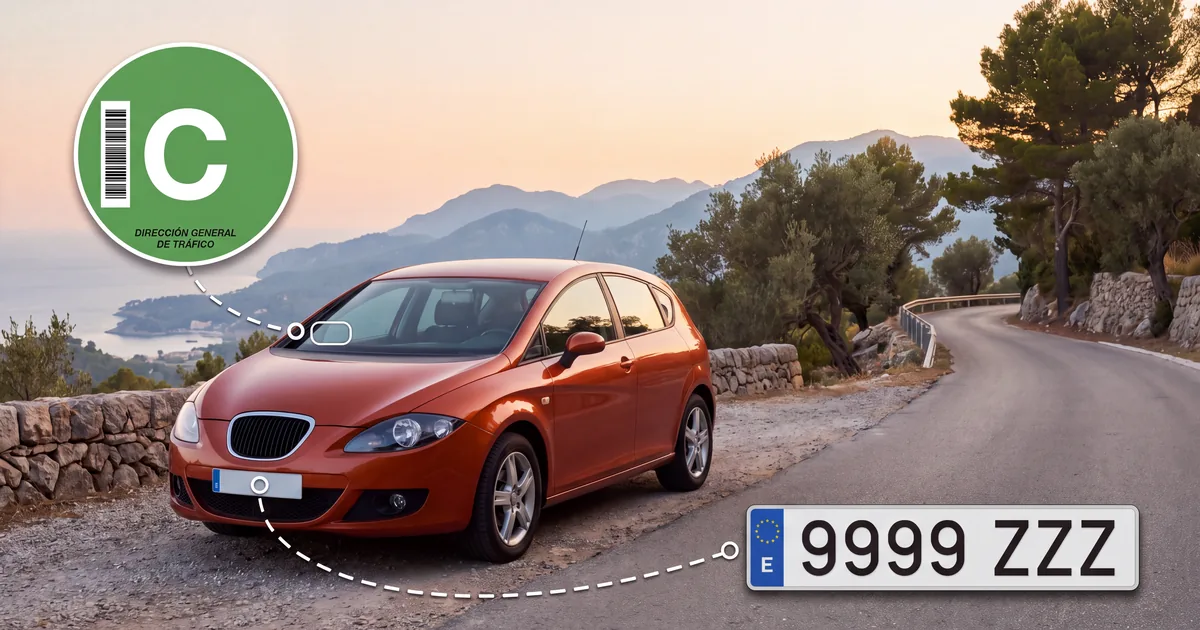
Registration still isn’t the end. There’s the distintivo ambiental, the round DGT sticker classifying your car by emissions. You buy it at a post office or a gestoría for a few euros and stick it in the bottom right corner of the windscreen.
The category depends on fuel and first registration date, and this is where a lot of English-language guidance is simply wrong. For passenger cars, per the DGT:
| Label | Petrol | Diesel |
|---|---|---|
| C (green) | first registered from January 2006 | from September 2015 (Euro 6) |
| B (yellow) | from 1 January 2001 | from 2006 (Euro 4) |
| none | before 2001 | before 2006 |
Hybrids and gas vehicles get ECO, and full electrics get the blue zero label. Watch the diesel C threshold in particular: the widely repeated “2014” figure applies to vehicles with more than eight seats and to goods vehicles, not to cars. For a car, diesel needs Euro 6, which in practice means September 2015.
One nuance that rescues borderline cars: the DGT defines the categories by Euro standard, not by model year, and the dates are only the practical shorthand the vehicle register works with. Euro 6 type approvals began in September 2014, so a diesel registered late that year can qualify for C. If your registration document or CoC proves the standard, ask for the classification to be reviewed with the paperwork attached rather than treating the model year as final.
Strictly speaking the rules don’t compel you to stick it on the glass, but without it you can’t enter a low-emission zone, and those are mandatory in towns above 50,000 inhabitants. Palma qualifies. Buying the sticker straight after you collect the registration document saves you explaining yourself at the first roadside check.
Note that you end up with two stickers on the windscreen, and only one of them comes from the DGT. The other is the distintivo V-19, the proof of a valid roadworthiness test, handed to you at the ITV station along with the pass certificate. It goes on the same glass and the same side as the emissions label, just higher up: the upper right corner as seen from inside the car. Here the rules are considerably firmer than for the environmental label. The V-19 is defined in the Reglamento General de Vehículos, driving without it is a traffic offence, and the fine is €100.
Its colour is not decoration but a code for the year the test expires, on a three-year cycle: yellow means 2026, red 2027, green 2028. That matters more on an older car, because past ten years of age the test is annual, so the colour on your windscreen changes just as often. Import a car in its teens and pass the test in 2026 and your sticker will be red, because the certificate runs out in 2027.
What it costs and how long it takes
My EU import took two months. Nothing went wrong and nothing was rejected; that’s just how the waiting adds up: the manufacturer’s CoC, several weeks for the pre-registration inspection, a week for the DGT appointment.
For a non-EU import, expect longer, and expect the range to be wider. Customs clearance itself is quick once the file is right. Homologation is the unknown: it depends on what the laboratory says your car needs, and any required modification adds its own lead time on top.
Fixed costs, whatever you drive:
| Item | Cost |
|---|---|
| DGT registration (tasa 1.1) | €99.77 |
| Plates, pair | approx. €30 |
| Environmental label | a few euros |
| Pre-registration inspection | per Consell de Mallorca tariff |
Non-EU costs on top:
| Item | Cost |
|---|---|
| Customs duty on a car | 10% of customs value |
| Import IVA (Balearics) | 21% of value plus duty |
| Individual homologation / ficha técnica reducida | quote it against your VIN; published figures vary very widely |
| Required modifications | depends entirely on the car |
| Customs agent / gestoría fees | typically a few hundred euros |
Then the two variable Spanish taxes: registration tax, which is zero below 120 g/km, and the annual road tax.
Why I’d pay for a gestoría this time
At the end of the Polish version of this article I wrote that a gestoría isn’t necessary. With an EU certificate of conformity and a full set of documents, the procedure is tedious but completely linear: collect papers, pay two taxes, go to the DGT. I stand by that.
For a non-EU import I’d say the opposite, and I’d say it firmly.
The reason isn’t the number of steps. It’s that the steps are coupled, and the expensive mistakes happen early, where you have the least idea what you’re doing. A customs value declared badly follows you through the duty, the import IVA and every subsequent recalculation. A residence relief missed by a fortnight is four figures gone with no appeal. A homologation file that doesn’t match the car sends you back through the laboratory and the ITV both. None of these is a wasted afternoon. They’re wasted months and real money.
Set that against the fee. A gestoría or customs agent handling an import is generally a few hundred euros. That’s less than a single miscalculated tax line, and considerably less than one botched relief claim.
There’s one more argument, less obvious. A gestoría that does imports regularly will tell you, before you spend anything, whether your particular car is worth importing at all. For a right-hand-drive car of ordinary value, the honest answer is often no: the duty, the IVA, the homologation and the modifications together can exceed what the car is worth. Finding that out in a €0 phone call rather than after the shipping invoice is, on its own, worth the price of the conversation.
So: get the digital certificate first, get the empadronamiento done, and before you book any transport, call somebody who does this every week and ask them what your car will actually cost to land, legalise and register. Then decide.
Correct as of August 2026. Fees and tax rates change, and the tax office assesses transfer-of-residence relief case by case. Municipal tax rates are indicative: the binding version is your own town hall’s current ordenanza fiscal, and customs valuations depend on your specific vehicle. Verify before you pay anything, with the DGT, AEAT / Agencia Tributaria and the Consell de Mallorca. My own import was from inside the EU: the customs, duty and individual-homologation sections here draw on AEAT guidance and specialist sources, not on first-hand experience.
I am not a lawyer, a gestor or a tax adviser. This is an account of one specific procedure I went through in 2026, not a guide. Your case may differ in exactly the details that decide the outcome here. Nothing in this article is legal or tax advice, and any decisions you take are your own responsibility.