 Mallorca.dev
Parking and the low emission zone on Mallorca: the fine you can undo, and the colour of the kerb
Parking rules and low emission zone boundaries are set by each town hall in its own ordenanza, so the amounts, hours and limits below are Palma's and may differ in Sóller or Pollença. This is a selection of what actually costs visitors money, not the Spanish highway code.
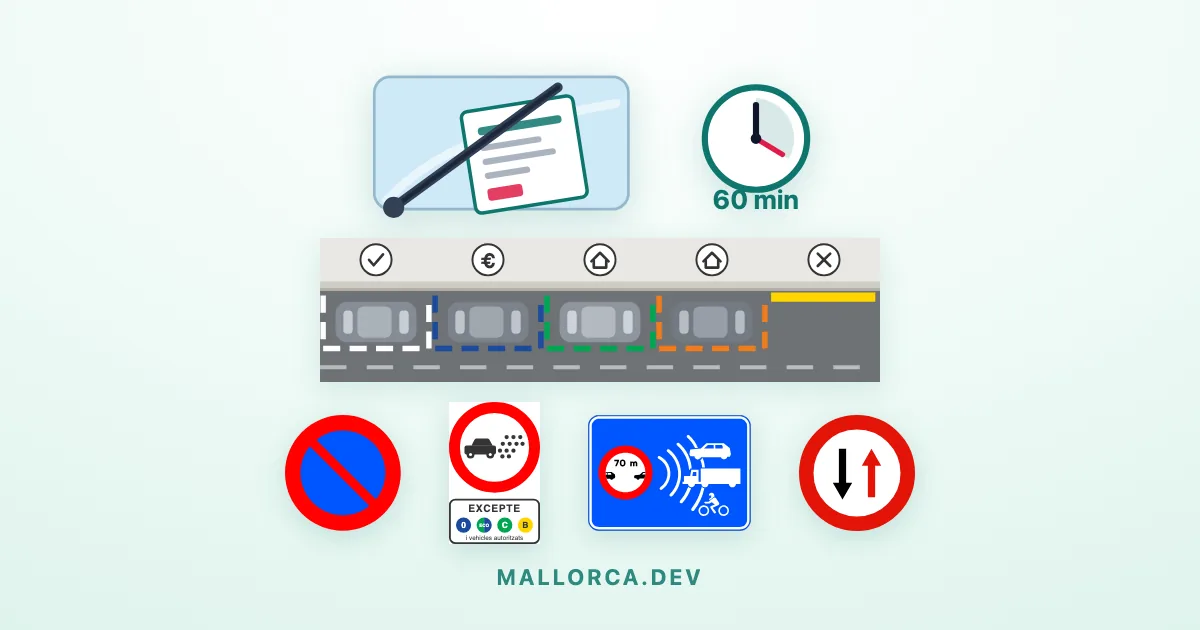
You come back to the car and there’s a slip tucked under the wiper. The instinct is the same everywhere: a fine, in a language you don’t read, which will follow you home by post. Not necessarily.
In Palma that slip isn’t a penalty yet. It’s a clock, and it has been running for a while already: for one hour after your ticket expired it can be stopped at the nearest meter for a few euros. We’re starting there because it’s the only thing in this article that works retroactively. The rest is about not getting the slip at all, and the first instinct to adjust is this: look down before you look up. In a Spanish city the right to park is usually announced by the colour at the kerb rather than by a sign, because often there isn’t one. Usually, because when a sign is there and contradicts the paint, the sign wins. That one gets a section of its own, because it’s the thing drivers get wrong most.
The slip under the wiper is a clock, not a fine
An ORA inspector who finds a car with an expired ticket leaves an aviso de denuncia. It’s a notice, not a penalty, and it can be cancelled for small change instead of the full amount:
| Zone | Cancellation cost |
|---|---|
| Zone 1 (inside the Avenidas, Cala Major) | 6.00 € |
| Zone 2 (Corona Ensanche) | 5.50 € |
| Zone 3 (Mercado de Levante, Pere Garau) | 3.50 € |
One detail decides everything here: the hour runs from the end of the parking you paid for, not from the moment the inspector left the slip. Article 59 of the city’s ordenanza de circulación puts it plainly, granting the special ticket effect “during the hour following the end of the previously authorised period”. So if your ticket expired at 12:00 and you get back at 12:50, you have ten minutes, not sixty. Check the time printed on the notice before you decide there’s room for a coffee.
That has a second consequence worth knowing in advance. Once you are more than sixty minutes past the paid period, the car may be towed: the ordenanza lists that case alongside parking with no ticket at all. The hour isn’t a margin of tolerance, it’s a window, and it closes expensively.
The procedure itself takes two minutes: go to the nearest meter, choose the cancellation option, enter the notice number and your registration, pay, and keep the receipt. That slip is your only proof the matter is closed, and the rule requires you to produce it together with the notice itself, so leave both in the glovebox until you fly home.
There’s one catch worth knowing before you sprint to the meter: cancellation rescues an overstay, not a missing ticket. Bought a ticket and stayed too long, and you’re fine. Never paid at all, and the notice can’t be cancelled: it proceeds as a normal penalty.
That process runs like this. The penalty notice reaches the registered keeper’s address by post, you have 20 calendar days from notification, and two options. One is a 50% reduction for prompt payment. The other is an appeal. You can’t have both, because paying at the reduced rate closes the case and counts in law as dropping your objections. Put plainly: if you think the fine is wrong, don’t pay half in the hope of arguing later.
When you actually have to pay
Palma’s blue zone runs on weekdays from 9:00 to 14:30 and from 16:30 to 20:00, on Saturdays only until 14:30, and it’s free on Sundays and public holidays. Evenings, the long lunch break and the whole of Sunday cost nothing, which is a better surprise than the alternative.
Stays are capped at two hours (three in the Pere Garau sector), and you can’t extend the cap by buying a second ticket for the same space. You have to move the car. An hour in the centre costs about 1.45 €, two hours about 2.65 €, and it gets cheaper the further you are from the Avenidas. Pay at the meter or in the city’s mobiAPParc app, which has the advantage of warning you when time is running out. Motorbikes, scooters and bicycles don’t pay at all.
Residents get no separate kerb colour, just a resident’s card (24 € a year) for the sector they live in.
The colour under your wheels says the most
Spanish parking bays are outlined in colour, and most of the time that colour is the only instruction you are going to get:
| Colour | Meaning | Who may park |
|---|---|---|
| White | Free, no time limit | anyone |
| Blue | Paid zone (ORA) | anyone who pays |
| Green | Residents’ priority | visitors briefly, dearer |
| Orange | Same, other cities | as above |
| Yellow | Prohibition, see below | nobody |
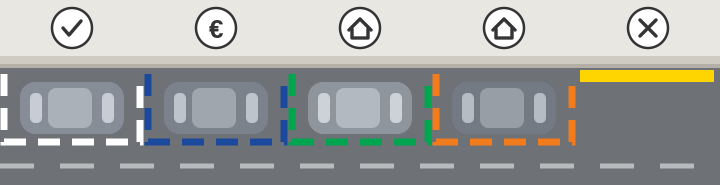
Two things worth knowing.
First, white does not mean “always allowed”. It means only that the bay carries no charge and no residents’ privilege. A nearby sign, a garage entrance or a residential zone still applies. That isn’t an exception to the rule, it is the rule, and it gets its own section below.
Second, green and orange are one idea in two liveries, not two categories. Madrid, Barcelona and Seville paint them green; Valencia and Alicante use orange. Someone who lives on that street parks there indefinitely and usually free; a visitor may stop, but for less time and more money than in a blue bay. Handing the resident that advantage is the entire point of the zone.
In Palma the question doesn’t arise, since the city runs only the blue zone and has neither green nor orange. You’ll need it on the ferry to the mainland, not here.
Yellow lines, and why British instincts fail here
This is the section to read twice if you learned to drive in the UK. Both countries paint yellow at the kerb, both use one line and two, and the meanings do not line up.
In Britain the number of lines encodes the timing: a single yellow means restrictions during posted hours, a double yellow means no waiting at any time. In Spain the number of lines is irrelevant. What matters is whether the line is solid or broken, and it encodes the type of prohibition, not its timing.
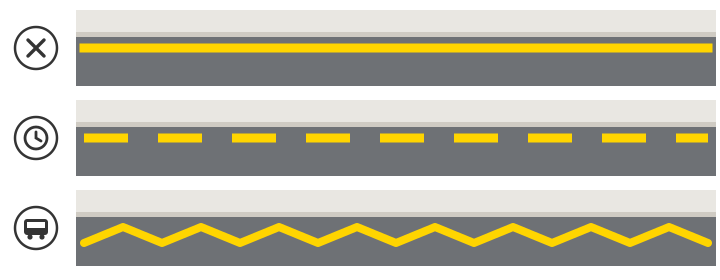
A solid yellow line means no stopping and no parking. You may not pull up even briefly, hazard lights on and driver at the wheel included. The only lawful stops are those forced by traffic or ordered by police.
A broken yellow line means no parking, but stopping is allowed. You may pause to let someone out or carry shopping in, provided you don’t obstruct traffic and don’t walk away from the vehicle.
A yellow zigzag marks a reserved space for a specific use: a bus stop, loading, emergency services. Parking is prohibited there whatever the hour.
And to clear up the assumption that follows a British driver around: the colour encodes no hours at all. If a restriction applies only from 8am to 8pm, or only on working days, a plate under the sign says so. The paint never does.
When the paint contradicts the sign, the sign wins
Sooner or later you will find a space telling you two things at once. A white bay outlined on the tarmac with a no-parking disc mounted above it. A blue ORA line beside a temporary roadworks board. The question is which one to obey, and Spanish law answers it directly.
Article 133 of the highway code (Reglamento General de Circulación) ranks instructions in order of precedence. Strongest first:
| Rank | Type of instruction | Example |
|---|---|---|
| 1 | Officers directing traffic | a police officer waving you on |
| 2 | Temporary signage and barriers | roadworks boards, cones |
| 3 | Traffic lights | the signal head |
| 4 | Upright signs | the disc on the post |
| 5 | Road markings | paint on the road and the kerb |
Paint comes last on that list. An upright sign beats the markings every time, not merely when it looks newer or more emphatic. Park in a spotless white bay with an R-308 above it and you are parked illegally, and the fine will stand. It works the other way too: a freshly painted blue line creates no paid zone on a street a temporary board has closed for works.
There is a second rule for two instructions of equal rank: the more restrictive one applies. Two contradictory plates on the same post are therefore resolved against the driver, not in their favour.
For a British driver this is the trap, and it is the opposite of the Polish one. In the UK the paint genuinely does the prohibiting: double yellows forbid waiting on their own authority, with no sign needed, so you learn to read the kerb and trust it. Spain paints more meaning at the kerb than Britain does, which makes the habit feel right, but the paint never acquired seniority. It gained content, not precedence.
Look at the top of the list and the logic becomes obvious. The ladder runs from the most current instruction to the most inherited one. The officer at the junction knows what happened thirty seconds ago, the roadworks board knows what is happening this week, and the paint remembers the last time someone repainted it, sometimes years back, half worn away by tyres.
Vado permanente, the sign that isn’t a road sign

The white-and-red or white-and-blue plate reading VADO PERMANENTE with a licence number hangs beside every garage door on the island. It isn’t a road sign in the strict sense but a licence issued by the town hall, for which the owner pays an annual fee.
Here’s what surprises even long-term residents: a vado does not reserve the space for the owner of the entrance. It only guarantees the entrance stays clear. Which is why the owner may not park in front of their own vado either. The regulations prohibit stopping in front of a marked entrance regardless of who is driving and who owns the building. The fine is 200 €, and the car usually leaves on a truck, because it is blocking someone in.
It cuts both ways. A vado is valid only with a municipal licence behind it. A yellow line painted by the owner, or a plate bought in a hardware shop, creates no prohibition at all.
Palma’s low emission zone (LEZ)
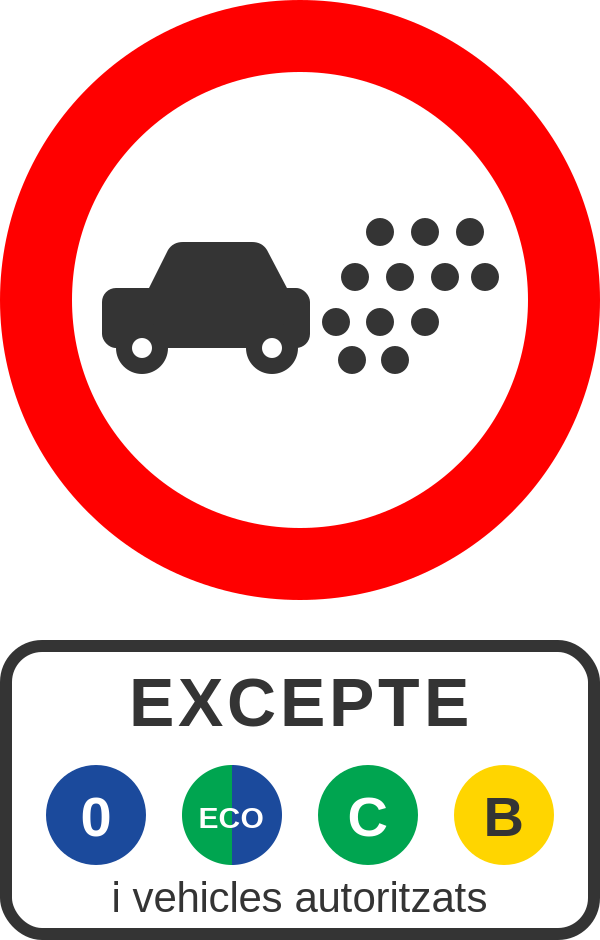
The sign is the R-120, identical across Spain: a red circle containing a vehicle emitting exhaust, with the whole message sitting in the rectangular plate beneath it, which is the part to read. In Palma the plate is in Catalan and admits four categories: 0, ECO, C and B.
Palma has had a zona de bajas emisiones since 22 December 2024, with 200 € fines for entering without authorisation enforced from 1 July 2025.
The names multiply, and they all describe one system. Spanish signs and council forms say zona de bajas emisiones, ZBE, which is the abbreviation to search under for anything specific to Palma. English-language sources call it a low emission zone, LEZ, the same label London uses for its own scheme, and the permit that goes with it turns up as a DGT sticker, an emissions sticker or an environmental badge.
Where the zone actually is
The first phase is called Centre Ciutat and covers the area inside the ring of the Avenidas, plus the strip between it and the sea. The Avenidas follow the line of the old city walls, so the boundary of the zone is effectively the boundary of the old town, not of Palma.
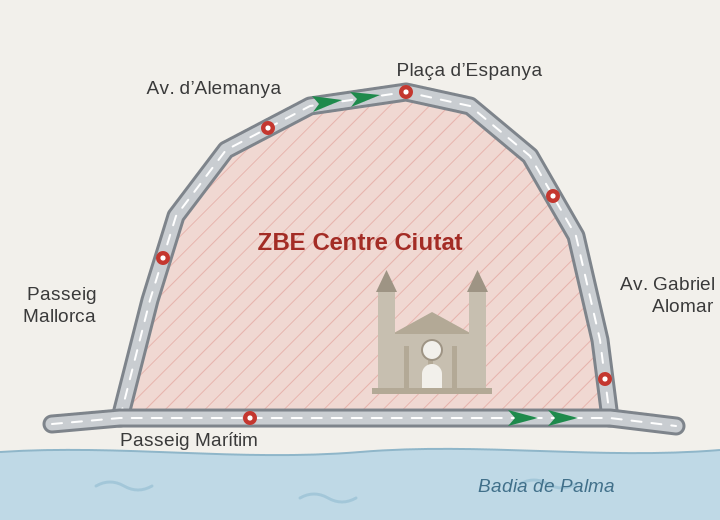
The full ring, in the order the ordenanza lists it: Avinguda Gabriel Roca, the stretch at the mouth of the Riera, Passeig Mallorca, Avinguda Portugal, Avinguda d’Alemanya, Avinguda Comte de Sallent, Avinguda Gran i General Consell, Plaça d’Espanya, Avinguda Alexandre Rosselló, Avinguda Gabriel Alomar, Avinguda Adolfo Suárez and back to Avinguda Gabriel Roca.
Two things the sign itself never tells you, and both decide whether you are fined.
Anyone may drive the ring. The Avingudes and the Passeig Marítim sit outside the zone, so a car with no authorisation can circle the centre, reach the port and leave the city. Only turning inwards is prohibited. That is the difference between “I can’t drive into Palma” and “I can’t drive into the old town”, and visitors mix the two up constantly.
The zone never switches off. The ordenanza sets its period of application as continuous, so there is no night, no Sunday and no lunch break here, unlike the blue zone described above. Meter hours have nothing to do with the ZBE.
Nobody looks at the sticker on your windscreen
Enforcement runs on cameras reading number plates around the ring, not a warden peering through your windscreen. The system pulls the vehicle’s category from the DGT database, so displaying a sticker is not a condition of entry in Palma. It is still worth having for a different reason: enforcement on the mainland is sometimes visual, and a few euros for the disc is the cheapest item in this whole business. Officially it is the distintivo ambiental; in English you will see the same thing called a DGT sticker, an emissions sticker or an eco sticker.
The rules tighten in stages. From 1 January 2027 category B loses access, and from 1 January 2030 only ECO and zero-emission vehicles remain.
Foreign plates: the Euro standard matters, not the sticker
This is where the sticker logic stops working altogether. The DGT classifies only vehicles registered in Spain, so a UK, German or Polish car cannot hold a distintivo, and the camera will not find it in any database. The council’s answer is a register: you enter the vehicle, and authorisation is granted on the basis of its Euro standard and date of first registration.
The thresholds in force now:
| Vehicle type | Condition for entry |
|---|---|
| Cars and light vans, petrol | registered from January 2000, Euro 3 |
| Cars and light vans, diesel | registered from January 2006, Euro 4 or 5 |
| Over 8 seats and goods vehicles | registered from 2006 |
| Motorcycles and mopeds | Euro 2, registered from 2003 |
From 1 January 2027 the bar rises: petrol from January 2006 (Euro 4, 5 or 6), diesel only from January 2014 (Euro 6). So if you are coming for a longer stay in a 2010 diesel, you can enter today and won’t be able to in eighteen months.
The authorisation from the register is time-limited, and how long depends on who you are. The revision to Annex 2 published on 24 March 2026 gives an ordinary visitor 30 days, counted from the entry date requested, and reserves six months for residents registered inside the zone and for owners of a property, a garage space or a business at an address within it.
The deadline matters more than the duration: the registration has to be filed five days before you drive in, and the documents include proof of your arrival on the island, a ferry ticket for instance. Sorting it out once you are already here is too late.
There is one more thing to know before you park: the authorisation is not enough to leave the car inside the zone. At every registration route the council states plainly that the permit is for driving only, even though the Annex 2 table also lists foreign plates under the heading that covers parking. The contradiction sits in the documents themselves, and finding out which version is enforced costs 200 €. The safe move is simple: leave the car outside the ring of the Avenidas, or in a garage.
If you are moving here the conclusion is unchanged: foreign plates are a temporary arrangement by design. A second authorisation is granted only once you can document that re-registration onto Spanish plates has begun, or certify tax residency abroad.
Which is where one problem locks into the other. The distintivo is only issued once the car is on Spanish plates, and at that point the ZBE register’s deadline stops being your problem. The whole procedure, with costs and the order of the steps, is in the separate piece on importing and registering a car in Spain.
The signs that read differently here
Spain follows the Vienna Convention, so the upright signs read much as they do across Europe: triangles warn, circles forbid, rectangles inform. These are the ones that still catch people out.
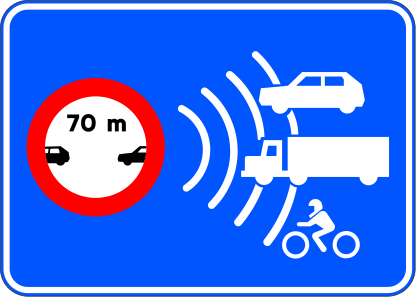
Distance enforcement (S-991f) is the one sign here with no British equivalent. It entered the Spanish catalogue on 1 July 2025 and announces automated measurement of the gap between vehicles rather than speed. Cameras and sensors calculate the distance and issue the penalty themselves: 200 € and four licence points. Cruise control set to the limit is no protection, because the quantity being measured is a different one entirely. The sign appears only on autopista and autovía.

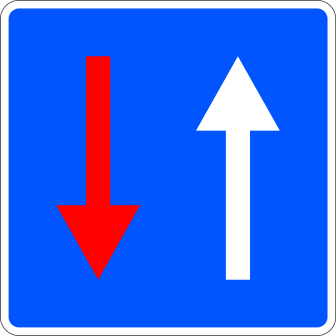
Priority at narrow sections (R-5 and R-6) has direct British equivalents, so the point isn’t novelty, it’s frequency: on the narrow sections of the Serra de Tramuntana, through old village centres and over single-lane bridges you’ll meet the pair a dozen times in an afternoon, and they decide who reverses. One trick: red always marks the side that must wait. With no sign at all and a road too narrow to pass, whoever has the obstruction on their side gives way, and on a gradient the vehicle travelling uphill has priority.
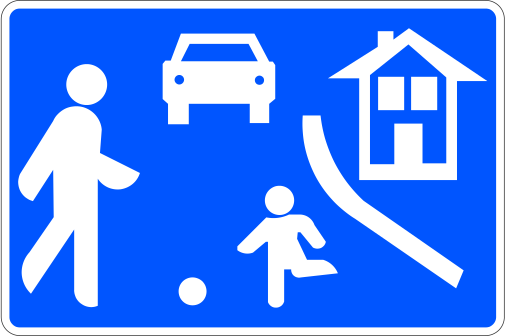
Residential zones (S-28) work like a British home zone: 20 km/h, pedestrians have priority across the full width of the street, children may play in the road. The zone runs until sign S-29 appears, not until the next junction, so it can persist for several blocks of an old town. The expensive part is the last rule: parking only in marked bays, and in the lanes of Palma’s old town there may be three of those on the whole street.
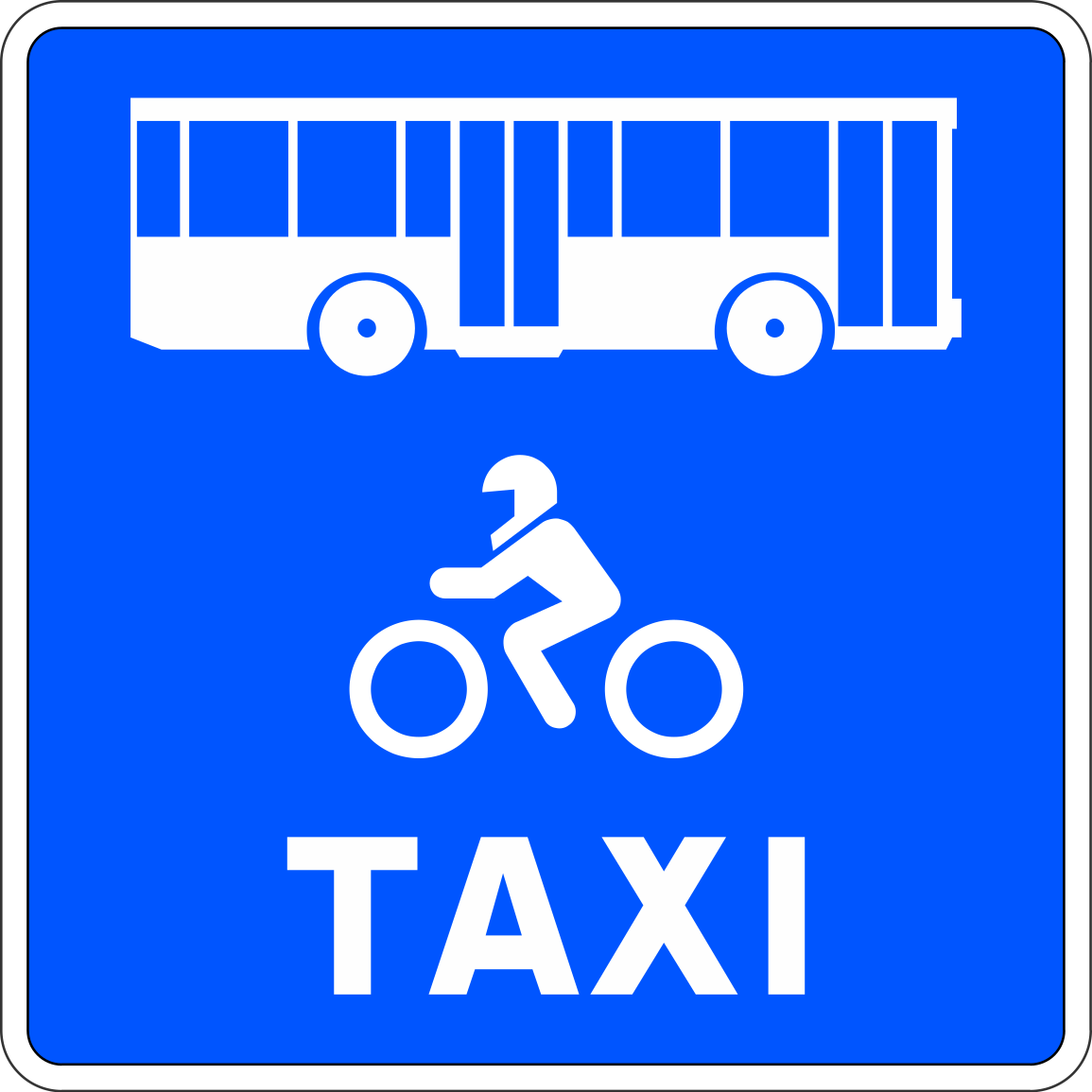
Reserved lanes (S-51a) list the vehicles allowed rather than simply saying “bus lane”. In the high-occupancy version (carril VAO) legality depends on how many people are in the car, and an environmental sticker does not substitute for that. Using one without qualifying costs 200 €.
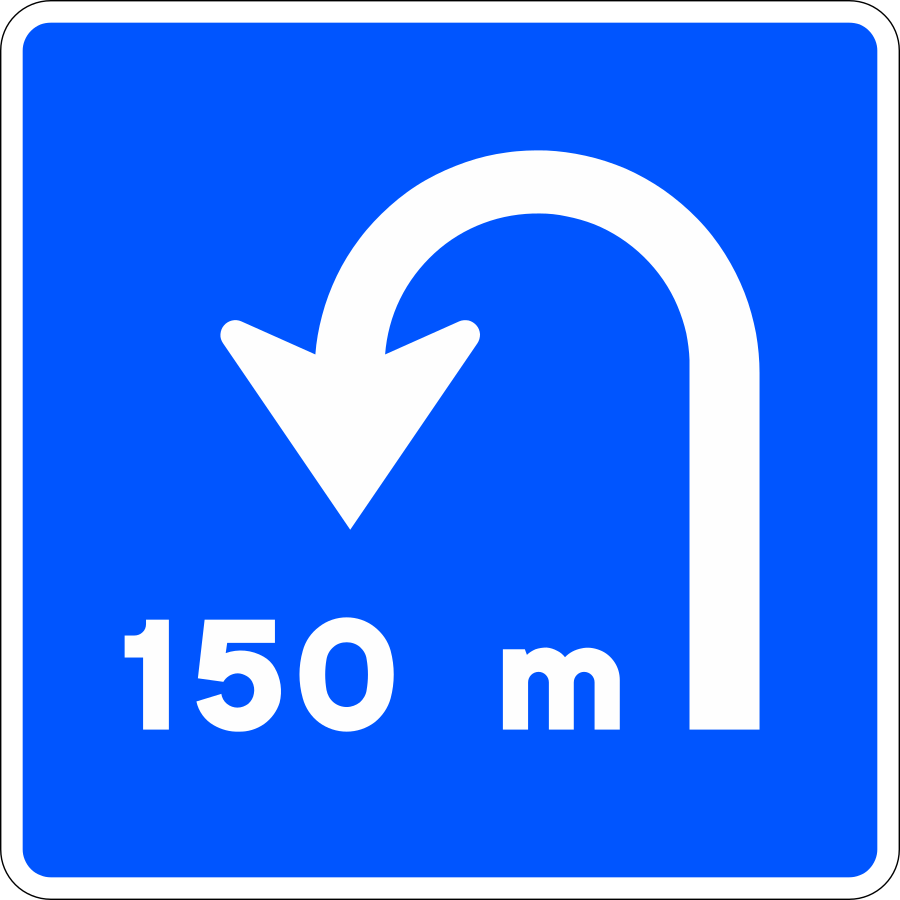
U-turn points (S-22) matter because Spanish main roads are sparing with turns across oncoming traffic. If your destination is on the far side, the standard move is to carry on to the next cambio de sentido rather than hunt for a gap in the central reservation.
Finally, the distinction people most often get wrong: autopista and autovía is not the same divide as toll and free. Limits are identical, 60 to 120 km/h, because Spain sets a minimum speed on them as well as a maximum. An autopista is built from scratch for cars only and is the only one that can carry a toll; an autovía is an upgraded existing road and never does. Mallorca has only autovías.
Quick reference
| Situation | Rule | Cost of the mistake |
|---|---|---|
| Notice under the wiper | One hour from ticket expiry | 3.50 to 6 € |
| No ticket at all | Cannot be cancelled | fine by post |
| More than an hour over | Past the cancellation window | fine and recovery |
| Blue bay | Ticket during ORA hours | 50% if paid promptly |
| White bay | Free unless signed | depends on the sign |
| Solid yellow | No stopping, no parking | fine and recovery |
| Broken yellow | No parking | parking fine |
| Vado permanente | Absolute, owner included | 200 € and recovery |
| Sign contradicts paint | The sign applies | fine despite the bay |
| ZBE, inside the Avenidas | Sticker 0, ECO, C or B | 200 € |
| ZBE, the ring itself | Open to any vehicle | none |
| Foreign plates in the ZBE | Register, filed 5 days before entry | 200 € |
| Foreign plates, parking in the ZBE | Permit covers driving, not parking | 200 € |
| S-991f | Distance enforcement | 200 € and 4 points |
Correct as of August 2026. Parking rules, tariffs, hours and cancellation charges are set by the council in its own ordenanza, so these figures are Palma’s and change independently of national law. Low emission zone thresholds and the sign catalogue change too. Check the current position with the DGT and Palma’s mobility service Mobipalma.
I’m not a driving instructor, a lawyer or a council official. This is a round-up of what causes visitors the most trouble, not a course in the Spanish highway code and not a complete statement of the rules in force. How you drive, where you leave the car, and what follows from those decisions, is your responsibility.
Frequently asked questions
Can I drive into Palma without a Spanish DGT environmental sticker?
Into Palma yes, into its old town no. The low emission zone, or LEZ, covers only the area inside the ring of the Avenidas plus the seafront strip. The Avenidas themselves and the Passeig Marítim lie outside it, so a car without authorisation can drive right around the centre, reach the port and leave the city. Only turning inwards is prohibited, and the fine is 200 euros.
What hours does Palma's ZBE operate?
It never stops. The ordenanza sets the period of application as continuous, so the zone applies 24 hours a day, including Saturdays, Sundays and public holidays. That makes it quite unlike Palma's paid parking zone, which has hours and is free on Sundays.
Can a UK or other foreign-plated car enter Palma's low emission zone?
Yes, but it has to be entered in the municipal ZBE register first. The DGT classifies only vehicles registered in Spain, so a foreign-plated car cannot hold an environmental sticker at all. Authorisation is granted on the basis of the Euro standard and first registration date instead: petrol from January 2000 (Euro 3), diesel from January 2006 (Euro 4 or 5). The application has to be filed five days before you drive in, and a visitor gets 30 days; six months is reserved for residents registered inside the zone and owners of a property or business there. It does not cover parking, because the council issues it for driving only.
In Spain, which wins: the road sign or the paint on the road?
The upright sign. Article 133 of the Spanish highway code ranks instructions in order of precedence: officers directing traffic, temporary signage at roadworks, traffic lights, upright signs, and road markings last. So if you are parked in a white, unrestricted bay with a no-parking sign above it, you are parked illegally. Where two signs of equal rank conflict, the more restrictive one applies.
Is the slip under the wiper in Palma already a fine?
No. The paid-zone inspector leaves an aviso de denuncia, a notice, which can be cancelled at a meter for 3.50 to 6 euros depending on the zone. The hour you get runs from the moment your paid ticket expired, though, not from when the slip was issued, so in practice there is often much less of it left. Cancellation only rescues an overstay, never a complete absence of a ticket, and the meter receipt must be produced together with the notice.
What do yellow lines at the kerb mean in Spain?
Not what they mean in Britain. The number of lines carries no meaning in Spain; whether the line is solid or broken does. A solid yellow line prohibits both stopping and parking, so you may not pull up even briefly. A broken yellow line prohibits parking but allows you to pause to drop someone off or carry shopping in. A yellow zigzag marks a reserved space, usually a bus stop, a loading bay or emergency vehicles.
Can I take a hire car into Palma's low emission zone?
Usually yes. Hire cars run on Spanish plates, so the cameras find them in the DGT database, and rental fleets are new enough to fall into category C or ECO. Check the classification when you collect the car, because a fine reaches the rental company first, and it then passes on your details and normally adds an administration fee of its own. The same goes for a slip under the wiper in the paid zone: you can cancel it at a meter, but only while the car is still with you.
How much is parking in Palma's blue zone, and when is it free?
About 1.45 euros an hour in the centre and about 2.65 euros for two hours, getting cheaper the further you go from the Avenidas. Charges apply on weekdays from 9:00 to 14:30 and from 16:30 to 20:00, and on Saturdays until 14:30 only. Evenings, the long lunch break, Sundays and public holidays are free. Stays are capped at two hours and you cannot extend the cap with a second ticket for the same space.