 Mallorca.dev
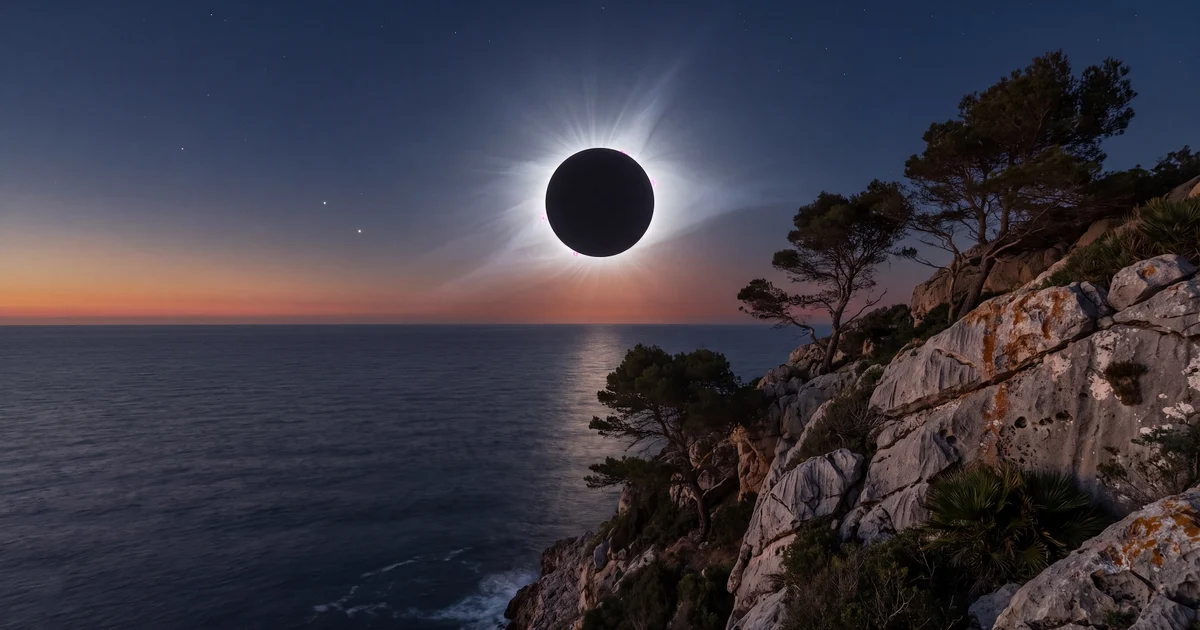
Total Solar Eclipse over Mallorca, 12 August 2026: Times, Best Spots and What to Expect
On Wednesday 12 August 2026, the whole of Mallorca falls inside the path of a total solar eclipse. For a little over a minute and a half the Sun disappears completely, and it happens minutes before sunset, barely above the sea. Spain hasn’t seen a total eclipse since 1905.
That last detail, the height of the Sun, is the single most important thing to plan around, and it’s the part most guides gloss over. During totality the Sun will stand only about 2 degrees above the horizon. Where you choose to stand decides whether you see the eclipse at all.
Times for Palma
| Phase | Local time (CEST) |
|---|---|
| Partial phase begins | 19:38 |
| Totality begins | 20:31 |
| Duration of totality | approx. 1 min 36 s |
| Eclipse ends | 20:49 |
Across the island the differences are a matter of seconds, so the Palma times work as a reference anywhere on Mallorca. If you want the exact second for a specific beach or viewpoint, use an eclipse calculator with precise coordinates.
Why this eclipse is different
Two degrees is roughly the width of two fingers held at arm’s length. In practice that means:
Anything to your west blocks the show. A hill, an apartment block, a line of pines. At 2 degrees there is no margin. You need a clear western horizon, ideally over open water. Elevation helps, but only if the view west is genuinely unobstructed. Haze near the horizon matters far more here than it would with a high Sun, so clear air improves your odds considerably.
The upside is real, though. An eclipse this low looks spectacular in a way a high one never can. Totality blends straight into sunset, and the whole sky changes, not just the solar disc.
Where to watch on Mallorca
The rule is simple: face west, over water, nothing in the way.
The northwest coast, around Sóller and Deià, opens west and northwest onto open sea. Sóller in fact lies very close to the centre line of the path of totality. The Serra de Tramuntana runs behind these towns rather than in front of them, so the sea view stays clear. Elevated viewpoints along this stretch are among the best options on the island.
The southwest coast, including Santa Ponsa, opens west and southwest with a wide sea horizon.
Palma is convenient and well connected, but the bay opens south and southwest, and the high ground west of the city can get in the way with the Sun this low. If you’re staying in Palma, a stretch of seafront promenade with a clear southwest view beats a random spot in town.
The interior is the weakest choice. At 2 degrees, the terrain between you and the horizon is the problem.
One tip worth taking seriously: check your spot in daylight a day or two beforehand, standing exactly where you plan to stand, looking west. Places that look fine on a map often aren’t.
Eye safety
This is not optional, and it’s where injuries happen.
Use eclipse glasses certified to ISO 12312-2. Sunglasses won’t do, however dark. Neither will exposed film, smoked glass or a phone screen.
Keep the glasses on through the entire partial phase, roughly 19:38 to 20:31 and again from 20:33 to 20:49. Only during totality itself, those ~96 seconds of a fully covered Sun, is it safe to look with the naked eye. The moment the first sliver of Sun returns, the glasses go back on.
Cameras, binoculars and telescopes need proper solar filters fitted at the front of the optics. Eclipse glasses held behind an eyepiece do not protect you. Buy from a reputable source now, not on the day.
Practical planning
Local authorities and astronomy groups are expecting record crowds, including visitors from the mainland.
The Tramuntana coastal roads are narrow and fill up fast, so arrive hours early, not minutes. Book restaurants and accommodation well ahead, and plan dinner clearly before or clearly after the event: 20:30 in mid August is normally the middle of dinner service. The eclipse ends essentially at sunset, which means you’ll be heading back in fading light and then darkness. Bring a torch if you’re on a coastal path.
There’s also a good reason to stay out late. The night of 12 to 13 August is the peak of the Perseid meteor shower, so from a dark spot in the Tramuntana you can go straight from the eclipse to shooting stars.
If you’re building the evening around a meal, our directory lists vetted places in the towns closest to the best viewing coast:
In short
Be somewhere on Mallorca’s west or northwest coast well before 20:31 on 12 August 2026, with open sea to your west. Wear ISO 12312-2 glasses until the Sun is fully covered, take about 96 seconds to enjoy one of the rarest sights in the sky, then put them straight back on.
Spain’s next total eclipse comes on 2 August 2027, but it won’t be total from Mallorca. For the island, this is the one.
Correct as of August 2026. The times given are for Mallorca and are indicative: each contact shifts by tens of seconds depending on exactly where you stand, and with the Sun this low the horizon matters too. Check the timings for your specific location before you set out, and check your glasses against the AAS list of reputable suppliers. Official figures for Spain are published by the Instituto Geográfico Nacional.
I am not an astronomer or an optometrist. This article gathers publicly available information about the event; it does not replace the safety instructions supplied with your glasses, or medical advice. You observe at your own risk. If you have any doubt at all about whether the Sun is fully covered, the glasses stay on. Retinal damage is painless and permanent.